

Metal halide vs LED? Is metal halide better than LED in 2026?
The short answer is no. In almost every measurable category—efficiency, longevity, and control—LED technology has decisively won the war.
However, if you manage a high-heat factory or a massive sports facility, the answer requires a bit more nuance. While LEDs outperform traditional lighting, not all LEDs share the same standard. Swapping a rugged metal halide fixture for a cheap, plastic-lens LED can actually lead to more headaches down the road.
We know the struggle. You aren’t just dealing with sky-high energy bills; you are dealing with the logistical nightmare of maintenance. Every time a light goes out in a 40-foot high bay, you aren’t just buying a bulb; you’re paying for boom lift rentals, labor, and facility downtime.
Here is the harsh reality: Metal Halide lamps are notoriously inefficient at maintaining brightness, losing up to 40% of their lumens within the first year.
That means you are paying 100% of the energy cost for only 60% of the light.
In this guide, we won’t just compare the two technologies. We will look at why industrial facilities are rushing to retrofit, and how to avoid the common pitfalls of switching to LED.
Before we dive into the ROI calculations and wattage charts, let’s briefly define what we are actually comparing. Understanding the mechanics is key to understanding the failure points.
目录
What is a Metal Halide Light?
Metal Halide (MH) is a type of High-Intensity Discharge (HID) lighting. For decades, it was the heavyweight champion of the industrial world.
Technically speaking, it works by passing an electrical arc through a mixture of gases (mercury and metal halides) inside a quartz tube. Think of it as a controlled, continuous lightning bolt in a bottle.
You can think of a 1000W Metal Halide lamp like an old-school, gas-guzzling muscle car from the 1970s.
- Powerful: It produces a very bright, intense white light.
- Inefficient: It generates a massive amount of wasted heat to produce that power.
- High maintenance: Just like an old engine, parts wear out fast, and performance drops significantly the longer you drive it.
For a long time, it was the only option for stadiums and warehouses. But today, its “engine” is simply too expensive to run.

What is a Light Emitting Diode (LED)?
LED stands for Light Emitting Diode. Unlike metal halide, which relies on burning gas and fragile glass tubes, LED is a form of Solid-State Lighting (SSL).
It generates light by passing an electrical current through a semiconductor material. When the electrons move, they release energy in the form of photons (light).
The Digital Revolution:
If Metal Halide is analog, LED is digital.
- Precision: It pushes light exactly where you need it, rather than scattering it 360 degrees like a bulb.
- Efficiency: It converts the vast majority of energy into light, not heat.
- 耐用性: There are no filaments to break and no glass bulbs to shatter.
However, while LEDs don’t radiate heat like metal halides, the internal electronics do get hot. And as we will discuss later, managing this internal heat is the difference between an LED that lasts 10 years and one that fails in 10 months.

Metal Halide vs LED: Performance Comparison
Numbers don’t lie. When we compare the technologies side-by-side, the gap in performance becomes undeniable.
However, as we mentioned earlier, not all LEDs are suitable for heavy industrial use.
Below is a comparison between the legacy technology (Metal Halide), the current market standard (Standard LED), and the future of industrial lighting (Cevonic FTC).
Metal Halide vs. LED Comparison Chart
| Parameter | Metal Halide(The Old Way) | Standard LED(Silicone/Phosphor) | Cevonic FTC LED(The Industrial Solution) |
|---|---|---|---|
| Lifespan (Service Life) | 10,000 – 15,000 Hours | ~50,000 Hours (L70) | 100,000+ Hours (LM-80 Verified) |
| Lumen Maintenance | Poor: Loses 40% brightness in year 1 | Average: Gradual decay due to heat | Superior: <5% decay over 100,000 hrs |
| Energy Efficacy | 60 – 80 Lumens/Watt | 130 – 150 Lumens/Watt | 160 – 180 Lumens/Watt |
| Chemical Resistance | Low (Corrodes) | Poor: Silicone absorbs sulfur (Blackening) | Excellent: Ceramic is impervious |
| Start-up Time | 15 Minutes (Warm up) | Instant On | Instant On |
| Heat Management | Radiates Extreme Heat | Traps Heat (Silicone barrier) | Conducts Heat (10 W/m·K) |
Why Is LED Replacing Metal Halide?
While there are dozens of technical reasons to switch, they all boil down to three main categories: Money, Performance, and Control.
Cost & Energy Savings
For most facility managers, the decision is simple: reduce operating costs.
Metal halide lamps are highly inefficient. They emit light in all directions (360°), relying on reflectors that waste energy. They also generate excessive heat.
Typical upgrade:
- 400W metal halide (≈455W with ballast)
- Replaced by 150W LED
That’s an instant energy reduction of up to 65%. In 24/7 operations, the payback period is often under 18 months.
Maintenance is another major cost.
Metal halide lamps last around 15,000 hours—but their usable life is shorter due to rapid lumen depreciation. In practice, replacements are needed every 2–3 years.
Each replacement involves:
- New bulbs and ballasts
- Lift equipment for high ceilings
- Labor costs
- Operational downtime
With LED (50,000–100,000 hours), you install once and run for years with minimal maintenance.
Many regions also offer utility rebates for LED upgrades—sometimes covering up to 50% of project costs. Metal halide systems do not qualify.

Performance & Light Quality
LED doesn’t just save energy—it improves lighting quality.
L70 (lumen maintenance) is the key metric:
- Metal halide can lose up to 40% brightness within a year
- LED maintains stable output for years
This means metal halide environments gradually become dimmer without notice.
Color quality is another issue:
- Metal halide CRI: ~60–65
- LED CRI: 70–80+
Higher CRI improves visibility, helping workers identify details, colors, and defects more accurately.
Metal halide also emits:
- IR (heat) → increases HVAC load
- UV → damages materials and attracts insects
LED produces virtually no UV or IR, making it safer for sensitive environments like food processing or textiles.
Control & Smart Functionality
Metal halide is limited to basic on/off operation.
LED enables full control:
- Instant-on (no warm-up or restrike delay)
- Dimming capability
- Integration with motion sensors and daylight controls
- Smart system compatibility (IoT, automation)
A brief power outage with metal halide can cause 15–20 minutes of downtime. LED restores full brightness instantly.
Smart controls can add another 20–30% energy savings on top of efficiency gains.
Thermal Impact
Metal halide fixtures operate at extremely high temperatures (over 2000°F internally), acting as heat sources within the facility.
In large installations, this significantly increases cooling demand.
LED runs much cooler, reducing HVAC load and lowering total energy consumption—especially in hot environments.
What Are the Disadvantages of LED Lighting in Industrial Environments?
As your consultant, I need to be honest with you. While LED is the superior technology, it is not invincible.
Many factory owners have been burned (literally) by switching to cheap LED replacements, only to see them fail within two years. Why does this happen?
Why Standard LEDs Fail in Harsh Industrial Conditions?
It’s not usually the chip itself; it’s the packaging.
Most standard LEDs on the market use a mixture of phosphor powder and silicone glue to cover the chip. While this works fine for your office, it has fatal flaws in a factory setting:
1. The “Sponge” Effect (Sulfuration): Silicone has a porous molecular structure. If your facility has sulfur, acidic fumes, or heavy oil mist (common in manufacturing, rubber plants, and livestock farms), these gases penetrate the silicone.
2. Blackening: Once inside, these chemicals react with the silver-plated reflection layer of the LED. This causes sulfuration (blackening). The silver turns black, absorbing light instead of reflecting it. The result? Drastic light loss and eventual failure.
3. Heat Trapping: Silicone is a poor thermal conductor. It acts like a blanket, trapping heat directly against the chip. As the temperature rises, the phosphor degrades, leading to color shifts and burnout.
If your environment involves:
- High Temperatures: (Foundries, Steel Mills).
- Chemical Exposure: (Poultry farms with ammonia, rubber factories with sulfur).
- Vibration & Dust: (Heavy machining).
In these conditions, a standard “Silicone + Phosphor” LED is a ticking time bomb. The “porous” nature of the packaging ensures that contaminants will eventually kill the light source.
The Turning Point: So, if Metal Halide is inefficient, but standard silicone-packaged LEDs are chemically vulnerable, what is the solution?
A Better Alternative: Ceramic LED Technology Explained
We’ve established that Metal Halide is obsolete. But we’ve also revealed the dirty secret of the LED industry: Standard silicone-encapsulated LEDs cannot survive harsh chemical and thermal environments.
This is why Cevonic developed the FTC (Fluorescent Transparent Ceramic) technology. We didn’t just improve the light; we changed the material science behind it.
Beyond Standard LED: The Ceramic (FTC) Revolution
在 Cevonic, we didn’t just tweak the LED bulb; we reinvented how heat is managed using FTC (Fluorescent Transparent Ceramic) technology.
Why FTC Solves the Problem:
FTC technology replaces the traditional “phosphor powder + silicone” mixture with a solid, Fluorescent Transparent Ceramic material. This shift fundamentally solves the failures of standard LEDs.

1. Immunity to Sulfuration (The “Shield” Effect)
Unlike porous silicone, our FTC material is a solid, dense ceramic structure. It is physically impervious to sulfur, ammonia, acids, and alkalis.

The Result: Corrosive gases cannot penetrate to the silver layer. Even after rigorous 168-hour anti-sulfuration testing, Cevonic chips show zero blackening. Whether you are running a poultry farm (ammonia) or a tire factory (sulfur), the light stays bright.
2. Unmatched Thermal Conductivity (10 W/m·K)
Heat is the enemy of light. Silicone is a thermal insulator, but Ceramic is a thermal conductor.
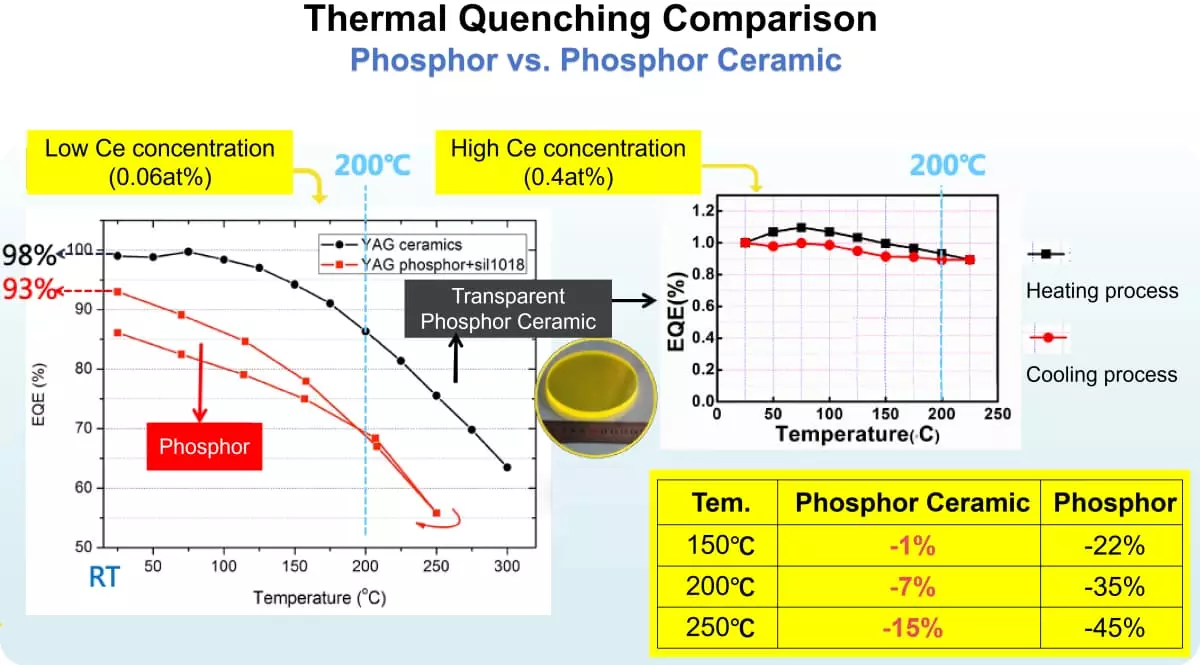
The Data: FTC has a thermal conductivity of up to 10 W/m·K.
The Benefit: It pulls heat away from the junction 50 times faster than traditional silicone packaging. This allows our lights to operate at high power densities (replacing 1000W+ Metal Halides) while keeping the surface temperature low (avg. 89°C).
3. Zero Light Decay (<5% over 100,000 Hours)
Because we eliminated the heat-trapping silicone and the degrading phosphor powder, our stability is unmatched.
Standard LED: Often loses 30% brightness in 50,000 hours.
Cevonic FTC: Verified to have less than 5% luminous attenuation after 100,000 hours.
Case Use:
For facility managers who are tired of replacing “industrial” LEDs that dimmed or failed due to chemical corrosion or heat, Cevonic offers the first true “Install and Forget” solution.
How to Convert Metal Halide to LED?
Ready to make the switch? Let’s look at how to actually get it done right.
You generally have two options: Retrofit (keeping the old housing) or Replacement (new fixtures).
- Corn Bulbs (Retrofit): Screwing an LED “corn lamp” into the old Metal Halide socket. Verdict: Cheap, but often overheats because the old fixture traps heat. Not recommended for long-term industrial use.
- New Fixtures (Replacement): Taking down the old heavy box and installing a dedicated LED high bay. Verdict: The professional choice. Better heat dissipation, better optics, and longer life.
If you decide to retrofit, you cannot simply screw an LED bulb into a Metal Halide fixture. You must perform a Ballast Bypass.
The ballast is the device that regulates voltage for the Metal Halide arc. LEDs have their own internal drivers. If you run an LED through an old ballast:
- You are wasting energy (the ballast consumes power).
- You risk blowing out the LED driver.
- The ballast is a failure point—if it dies, your new LED goes dark.
Always have a certified electrician cut the ballast out of the circuit.
Use this rule of thumb when planning your upgrade to ensure you maintain the same brightness levels:
- 400W Metal Halide → Replace with 100W – 150W LED (Target 15,000 – 20,000 Lumens)
- 1000W Metal Halide → Replace with 300W – 400W LED (Target 40,000 – 50,000 Lumens)
- 1500W Sport Light → Replace with 500W – 600W LED (Target 70,000+ Lumens)
结论
The debate is over. Metal Halide vs LED is no longer a question of “if,” but “when.”
Sticking with Metal Halide is a financial leak. However, rushing into the wrong LED investment (standard silicone LEDs) can be just as costly when they fail due to sulfuration or heat.
Ready to stop changing lights?
Look beyond the sticker price and consider the Lifespan and Reliability. A Cevonic fixture offers the durability of ceramic with the efficiency of LED.
Contact Cevonic Today for a free lighting simulation. Let us show you exactly how much you will save over the next 10 years.
FAQ (Frequently Asked Questions)
Q: What is the LED equivalent to a 400W metal halide?
A: Generally, a 150W LED fixture is the equivalent. However, look for 15,000 to 20,000 lumens to ensure equal brightness.
Q: Why do my LED lights burn out so fast?
A: The #1 cause is packaging failure due to heat or chemical corrosion. Standard LEDs use silicone, which traps heat and allows sulfur to blacken the silver layer. Ceramic-based LEDs (like FTC) solve this issue.
Q: Is LED better than HPS for 2026?
A: Yes. High-Pressure Sodium (HPS) produces poor orange light. LEDs provide superior color rendering (CRI), instant-on capability, and better energy efficiency.
Q: Can I put an LED bulb in a metal halide fixture?
A: Yes, but you must perform a Ballast Bypass. Leaving the old ballast connected will waste energy and damage the LED.

 English
 Français
 Deutsch
 日本語
日本語 Русский
 Español
 简体中文
简体中文