

Winter brings freezing temperatures and significantly shorter days. For small-to-medium farm owners and dedicated poultry keepers, this usually means one frustrating thing: a sudden, precipitous drop in egg production.
But a mid-winter egg drought isn’t something you simply have to accept. While you can’t control the weather, you can control the environment inside your barn. By installing the right chicken coop lights for winter, you can trick your flock’s biological clock, keeping your hens happy, healthy, and laying consistently straight through to spring.
Here is exactly how to set up your winter lighting, the safety hazards you must avoid, and the equipment you need to succeed.
目录
Why Do Chickens Need Light in Winter? (The 14-Hour Rule)
To understand why winter lighting is so critical, we need to look at poultry biology first. A hen’s reproductive cycle is directly tied to daylight. Light enters the hen’s eyes and penetrates her skull to stimulate the pituitary gland, which triggers the release of hormones required to form an egg.
To maintain peak egg production, a hen needs 14 to 16 hours of continuous light per day.
During the peak of summer, nature provides this easily. However, in the depths of winter, natural daylight can drop to just 9 or 10 hours. Without supplemental lighting to bridge that gap, the hen’s body naturally goes into “survival mode,” halting egg production to conserve energy.
Want to dive deeper into the science of poultry vision and how different spectrums affect flock biology? Read our comprehensive chicken coop lighting guide.
Heat Lamps vs. LED Coop Lights: A Winter Safety Warning
One of the most dangerous mistakes poultry keepers make in winter is confusing light with heat.
Many people rush to the hardware store and buy infrared heat lamps (the large, red bulbs) to hang in their coops. We strictly advise against using heat lamps for your flock.
Fully feathered, adult laying hens are incredibly cold-hardy. They use their feathers to trap body heat and stay warm even in sub-zero temperatures. What they lack in winter is light, not heat.
- The Fire Hazard: Heat lamps operate at incredibly high temperatures. If a lamp falls, or if a chicken kicks dry bedding (straw, pine shavings, or dust) onto the bulb, it can ignite in seconds. Winter coop fires are a devastating and completely preventable reality.
- The Sleeping Disruption: Some keepers leave heat lamps on 24/7 to keep the coop warm. This destroys the chickens’ circadian rhythm. Birds need total darkness to sleep and maintain a healthy immune system.
If you are wondering about evening routines, check out our dedicated post: Do chickens need a light at night?
解决方案: You need a “cold” light source. High-quality LED fixtures are the safest light for a chicken coop in winter because they convert electricity into brilliant lumens, not dangerous waste heat.
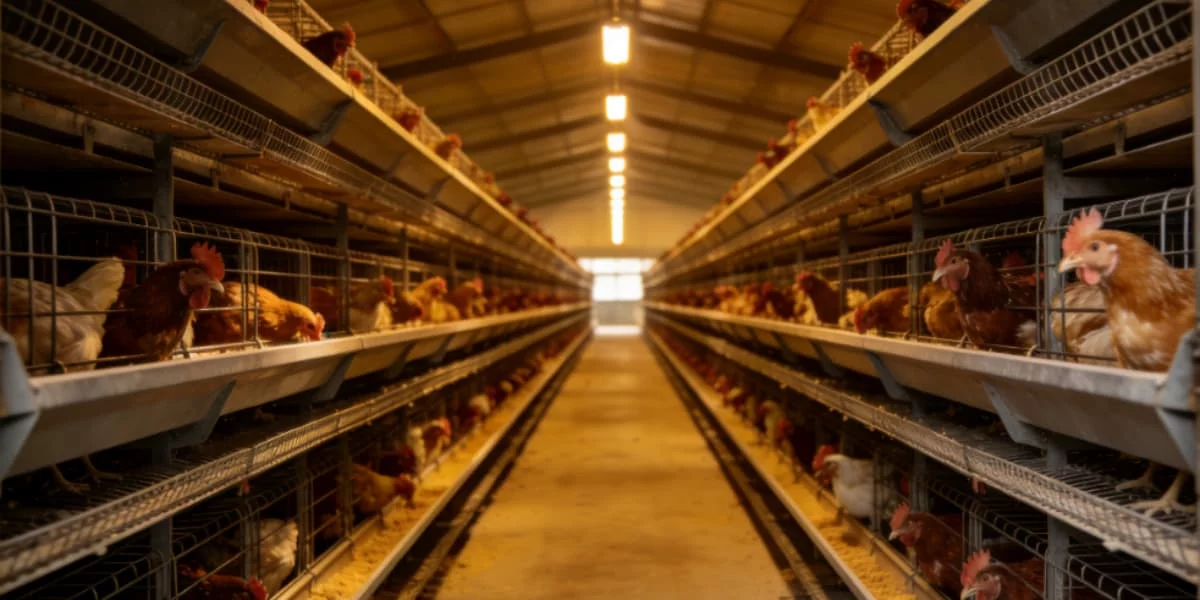
How to Choose the Best Light for a Chicken Coop in Winter?
Not all lights are created equal. A cheap residential light bulb from a local store will not survive the harsh environment of a poultry house. When selecting winter lighting, you must focus on three commercial-grade factors below:
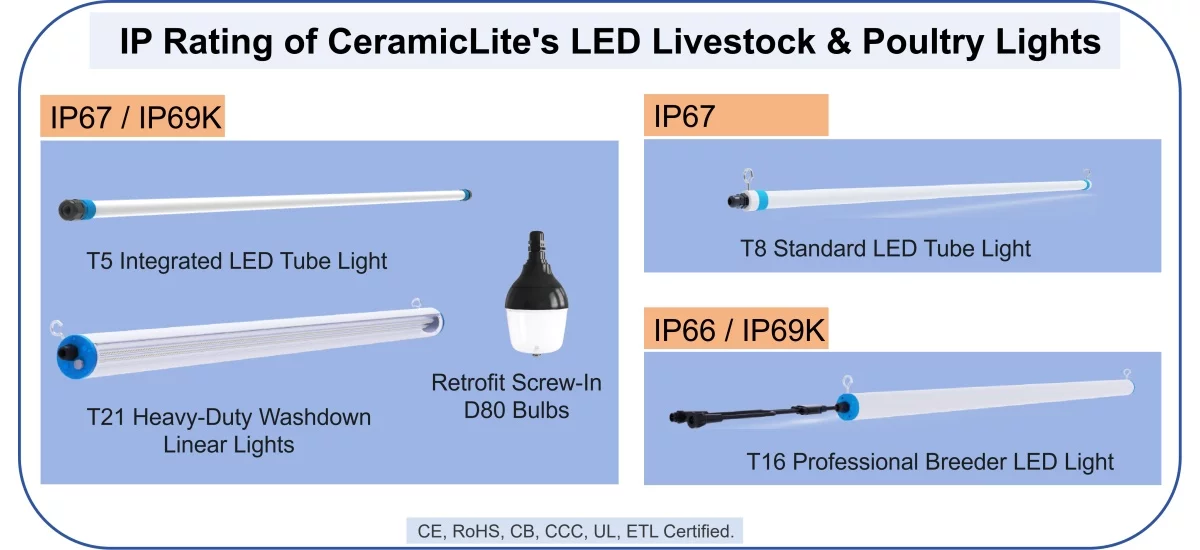
1. Durability and IP Rating (Why Cheap Bulbs Fail)
A chicken coop is a hostile environment for electronics. High concentrations of corrosive ammonia from droppings, airborne dust, and winter humidity will destroy standard bulbs in weeks. Thus, you need fixtures with an IP65 or IP66 waterproof and dustproof rating.
Cevonic‘s LED poultry barn lights are sealed and engineered specifically to withstand these caustic environments, saving you the headache and cost of constant replacements.
2. The Right Spectrum (Color Temperature)
For egg layers, you want to mimic the warm glow of the summer sun. Look for lights in the Warm White (2700K – 3000K) spectrum. This specific color temperature contains the red wavelengths crucial for penetrating the hen’s skull and stimulating reproduction.
For a deep dive into how lux levels and color temperatures maximize your yield, read our guide on how specific light spectrums impact egg production.
3. Flicker-Free Technology
Chickens have incredible vision. A cheap LED bulb that looks perfectly steady to a human may actually appear as a rapidly flashing strobe light to a chicken. Continuous “flicker” causes chronic stress, elevating cortisol levels and leading to aggressive behaviors like feather pecking. Always choose flicker-free LED drivers, like those used in Cevonic fixtures, to ensure a calm and productive flock.
How to Set Your Winter Lighting Schedule?
You have your new lights installed, but when should you turn them on? The golden rule of poultry management is: Always add supplemental light in the morning, never in the evening.
Here is why:
If you extend daylight into the evening and the timer suddenly shuts the lights off at 8:00 PM, your hens will be plunged into total darkness. They will be stranded on the floor, unable to see well enough to navigate back up to their roosting bars. This leads to birds sleeping on the cold, dirty floor, resulting in stressed hens and dirty “floor eggs.”
Best Practice Setup:
Set an automatic timer to turn your lights on at 3:00 AM or 4:00 AM (depending on your local sunrise) to give them their 14-16 hours total. Let the lights run until natural daylight fills the coop, then turn them off. In the evening, let the natural, gradual sunset signal to the flock that it’s time to settle down and roost instinctively.
Winter Chicken Coop Lighting: Quick Troubleshooting Guide
Even with a good schedule, winter throws curveballs. Use this quick diagnostic table if you notice issues with your flock:
| Symptom | Probable Cause | Corrective Action |
|---|---|---|
| Production stopped despite 14h light | Cold Stress or Calorie Deficit | Light stimulates the hormones, but the body needs fuel. Winter birds burn more calories staying warm. Increase feed protein levels and check the coop for drafts. |
| Cannibalism / Feather Pecking | Light Intensity Too High | If the light is glaring or too “cool/blue,” birds become hyperactive and aggressive. Dim the lights, or ensure you are using a warm (2700K) spectrum. |
| High Number of Floor Eggs | Shadows in Corners | Hens seek out dark, hidden places to lay. If the corners of the coop are darker than the nesting boxes, they will lay on the floor. Adjust your lighting layout to eliminate shadows. |
| Molting in Mid-Winter | Inconsistent Light Cycle | Did a breaker trip? Did the timer drift? Even a few days of irregular lighting can trigger a winter molt. Check your backup power and timers. |
结论
To sum up, providing the right chicken coop lights for winter is one of the highest return-on-investment (ROI) strategies you can implement. It bridges the gap between the dark days of winter and the peak production of spring, keeping your egg supply steady when prices are often at their highest.
However, success requires reliable, safe, and biologically appropriate equipment. Therefore, don’t risk your flock’s safety with dangerous heat lamps, and don’t waste money on residential bulbs that will quickly fail in a dusty coop.
Ready to winter-proof your production?
Equip your barns with Cevonic’s specialized poultry lighting solutions. Our IP66-rated, flicker-free LEDs are engineered for the harsh realities of farm life, ensuring your flock performs at its absolute peak.
Note: Are you managing a massive, automated facility with over 10,000 birds?
Explore our advanced, fully dimmable systems designed specifically for commercial poultry barn lighting solutions to maximize large-scale ROI.

 English
 Français
 Deutsch
 日本語
日本語 Русский
 Español
 简体中文
简体中文