

Did you know that proper éclairage des locaux d'élevage is more than just turning on a bulb? The right light acts as a powerful biological tool. It directly improves animal health, lowers chronic stress, and quickly increases your daily farm yields.
In this comprehensive guide, you will learn exactly how light affects different species. We will cover key performance metrics, specific animal requirements, and how to design smart lighting systems to maximize your return on investment.
Table des matières
What Is Livestock Lighting?
Livestock lighting refers to purpose-built illumination systems designed specifically for agricultural environments. Unlike regular human-centered lights, these systems are precisely tuned to match the biological and visual needs of animals like poultry, swine, and cattle.
Proper livestock lighting carefully controls three main factors: the spectrum, intensity, and photoperiod. By managing these elements, lighting becomes an active management tool. It regulates feeding habits, hormone levels, rest cycles, and overall growth.
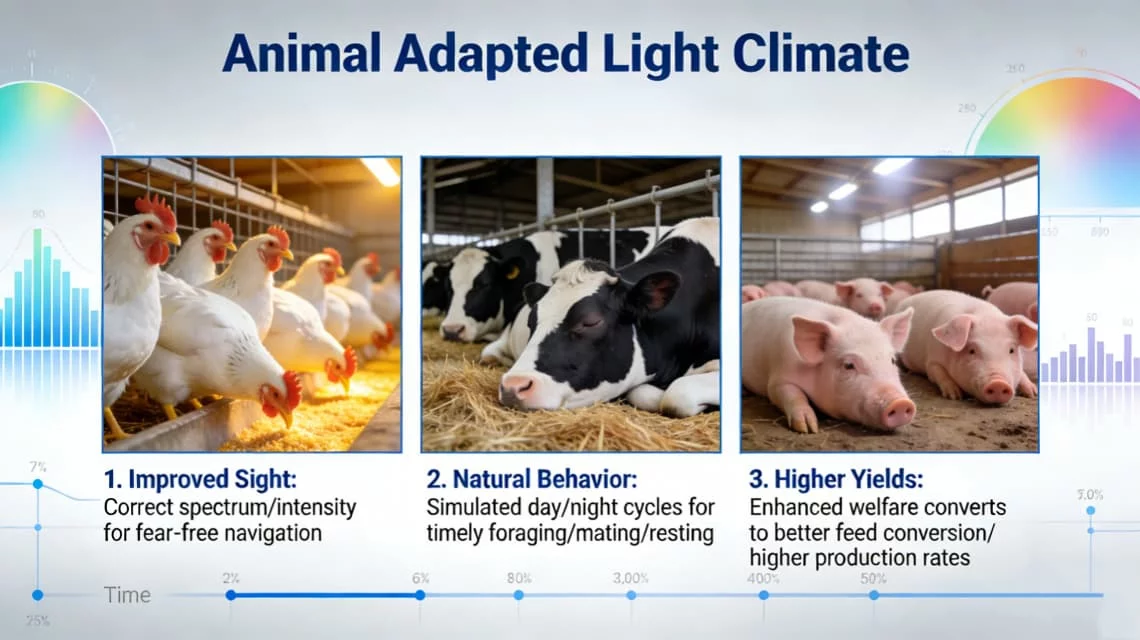
Why Livestock Lighting Matters for Health & Productivity?
For decades, farmers lit their barns mostly for human visibility. The traditional assumption was simple: if workers could see clearly, the lighting was sufficient. However, modern farming proves this is wrong.
Upgrading from human-centered lighting to animal-centered lighting directly impacts both biology and farm economics.
- Operational ROI: High-quality lighting makes farm management easier. High color rendering allows workers to identify illnesses quickly. Furthermore, specialized red lights allow non-intrusive night inspections, reducing handling risks.
- Biological ROI: Properly designed lighting influences animal physiology. A stable light spectrum and flicker-free technology reduce chronic stress. This leads to better immune responses, fewer health incidents, and more predictable growth across the herd or flock.
- Production ROI: Biologically correct lighting boosts output. For dairy cows, long-day photoperiods are closely linked to hormonal regulation, translating into higher milk yields. For poultry, correct lighting improves feed conversion rates.
How Livestock Actually Perceive Light?
To design effective lighting, we must realize a basic biological fact: animals do not perceive light the same way humans do. Differences in visual sensitivity, spectral response, and flicker tolerance mean that standard warehouse lights often cause stress in animals.
Animal Vision vs. Human Vision
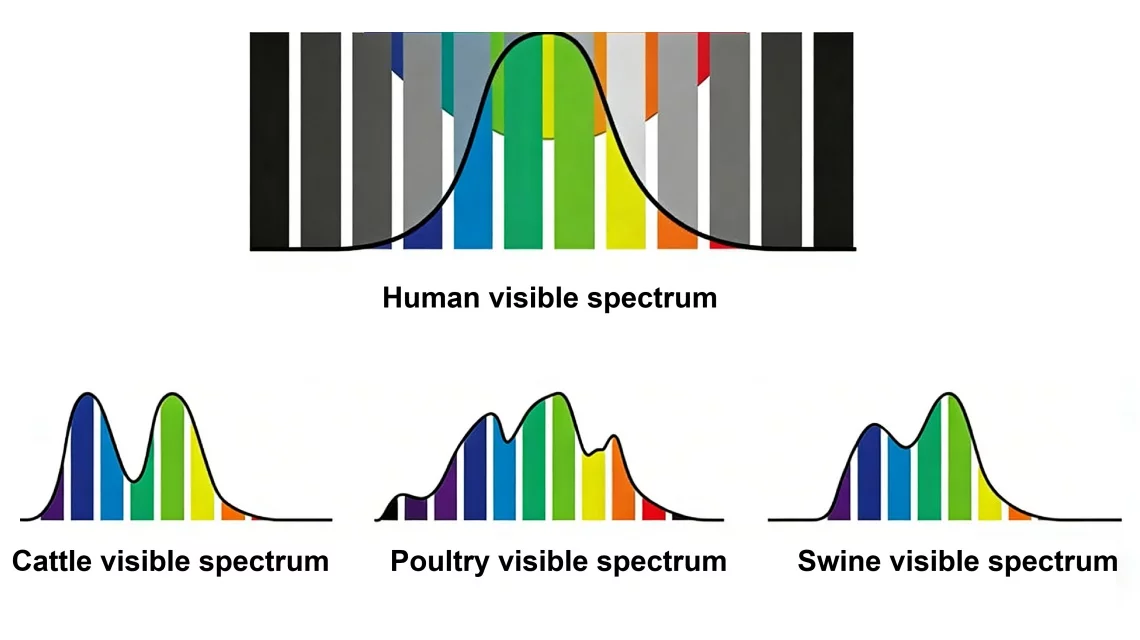
Humans and farm animals do not share the same visual spectrum. Humans have trichromatic vision, seeing wavelengths from approximately 400 to 700 nanometers, with peak sensitivity in the green-yellow range. Standard lighting metrics like Lux and CCT are based entirely on this human range. They completely ignore how animals see color and contrast.
- Cattle & Swine: Unlike humans, these animals have dichromatic vision with a narrower range, typically seeing between 400 and 600 nanometers. They are highly sensitive to blue and green wavelengths but lack red light receptors. Because they cannot properly perceive light beyond 650 nm, farmers can safely use dim-to-red lighting to monitor them at night without disrupting their sleep. Additionally, they rely heavily on brightness contrast, meaning harsh shadows easily trigger startle responses.
- Poultry: Birds possess the most complex visual system on the farm (tetrachromatic vision). They see a massive spectrum ranging from 315 to 750 nanometers. In addition to strong sensitivity in the blue, green, and red ranges, they can clearly perceive ultraviolet (UV) light (315–400 nm). This expanded UV vision greatly influences their feeding behavior, spatial awareness, and social interactions. If you provide an incomplete light spectrum, it creates stressful “blind spots” in their environment.
Flicker: The Invisible Stressor in Livestock Facilities
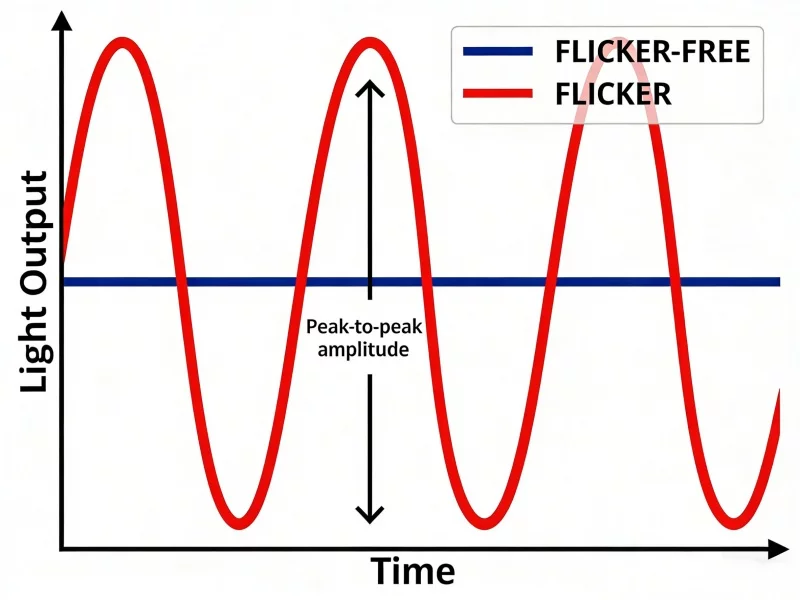
Flicker is a rapid fluctuation in light output that is often invisible to the human eye but detectable by many animals.
In livestock environments, especially poultry houses, flicker can act as a continuous source of low-level stress. Animals exposed to unstable lighting may show increased agitation, abnormal behavior, or changes in feeding and movement patterns over time.
Because flicker does not appear as a visible defect, it is frequently overlooked when industrial LED fixtures are used in barns. For livestock lighting, stable, flicker-free performance is a basic requirement, not an optional feature, to ensure consistent welfare and reliable production outcomes.
5 Core Metrics That Define Effective Livestock Lighting
You cannot evaluate barn lighting using standard human metrics. Effective livestock lighting must be measured by these five biological factors:
- Broad Spectrum: Narrow spectra distort how animals see their surroundings. A broad, biologically complete spectrum matches the animal’s natural vision and prevents stressful visual blind spots.
- Photoperiod & Intensity: How long the light stays on (photoperiod) is often more critical than peak brightness (Lux). Strict control of light duration regulates circadian rhythms and rest-activity cycles.
- CCT & CRI: Correlated Color Temperature (CCT) influences alertness. Cooler lights promote activity, while warmer lights calm animals. A Color Rendering Index (CRI > 80) is essential for workers to accurately inspect skin conditions and injuries.
- Flicker Control & Dimming: Rapid light fluctuations startle animals. Your system must feature stable, flicker-free drivers and smooth dimming to safely simulate natural sunrise and sunset.
- Durability (IP & IK Ratings): Barns are aggressive environments. Fixtures must resist high impacts, intense humidity, and corrosive ammonia gases.
https://en.wikipedia.org/wiki/Photoperiodism
https://en.wikipedia.org/wiki/Circadian_rhythm
Livestock Lighting Requirements by Species
While core principles remain the same, lighting strategies must be adapted to the specific biological traits of each species.
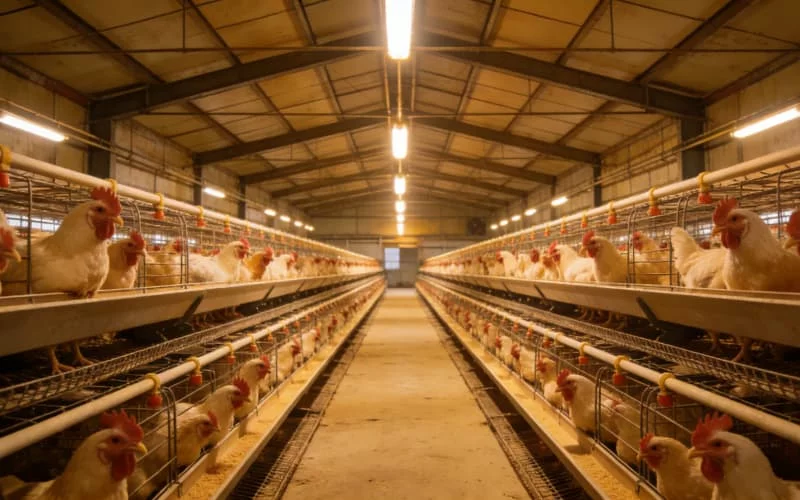
Poultry Lighting: Spectrum Accuracy & Growth
Because birds are highly sensitive to light quality, lighting directly controls their growth and social behavior.
Key Requirements: Ensure absolute flicker-free drivers to prevent chronic agitation. Use a broad-spectrum output that supports their complex UV vision.
Best Practice: Maintain high CRI (>80) lighting to reveal feather conditions and feeding activity clearly. Smooth dimming is required to manage lighting phase transitions safely.
For a deeper analysis of how lighting influences poultry growth and production, see our detailed guide on how poultry lighting affects production and growth.
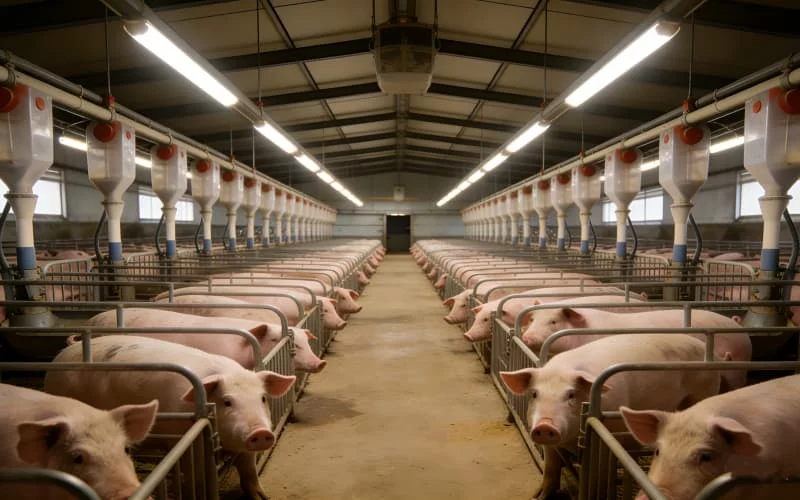
Swine Lighting: Durability & Night Inspection
Pigs are highly active, making mechanical durability just as important as biological performance.
Key Requirements: Use fully enclosed fixtures with high IK ratings to resist physical impact and tampering. Materials must be highly resistant to ammonia.
Best Practice: Apply dim-to-red lighting for night-time inspections. This allows workers to monitor the barn safely without disturbing the pigs’ circadian rhythms.
Cattle & Dairy Lighting: Long-Day Photoperiods
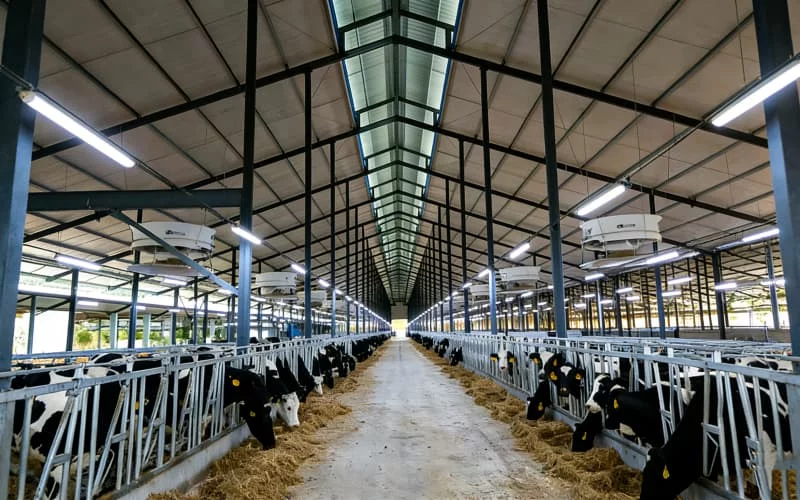
In dairy operations, light is closely tied to milk production through hormonal regulation.
Key Requirements: Implement a structured long-day photoperiod. This typically means providing 16 hours of light followed by 8 hours of darkness.
Best Practice: Maintain extremely high illumination uniformity. Cows are easily scared by shadows and glare, so smooth, shadow-free lighting improves movement safety.
Explore detailed strategies in our Cattle Lighting Guide.
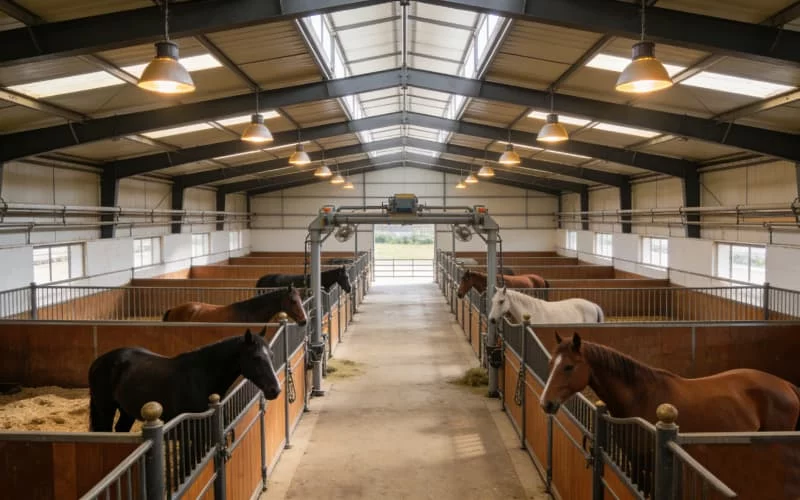
Equine Lighting: Safety & Shadow Reduction
Horses are highly sensitive to contrast, harsh shadow edges, and sudden brightness changes.
Key Requirements: Provide uniform, low-glare illumination.
Best Practice: Prioritize fixture placement to minimize harsh shadows in stalls and walkways, putting animal safety first.
How to Design a Livestock Lighting System? (Step-by-Step)
Effective lighting is a system-level decision. Follow these steps to implement a successful design:
- Select the Proper Spectrum: Choose fixtures that output the exact light wavelengths your specific animals need to see clearly and stay calm.
- Define the Production Goal: Identify your specific target. Are you optimizing for dairy milk yield, poultry feed conversion, or swine breeding?
- Determine the Photoperiod: Set your lighting timers based on the species. For example, use 16-18 hours for dairy cows, but adjust dynamically for poultry growth stages.
- Map for Uniformity: Use professional lighting design software to map the barn. Your goal is to achieve high uniformity to eliminate dark spots and shadows.
How to Choose the Right Livestock Lighting Fixtures?
Generic industrial LED lights are built for clean environments and human tasks. When installed in barns, they suffer from rapid degradation, poor dimming, and biological mismatch.
Traditional LED vs. Professional Livestock Lighting
| Caractéristique | Generic Industrial LED | Professional Livestock LED |
|---|---|---|
| Visual Stress | High flicker rates | 100% Flicker-free drivers |
| Spectrum Design | Narrow (Built for humans) | Broad (Matches animal vision) |
| Material Stability | Corrodes easily in barns | Ammonia, dust, & moisture resistant |
| System Control | Steps or unstable dimming | Smooth 0-100% sunrise/sunset dimming |
Why Purpose-Built Livestock Lighting Matters?
Generic industrial luminaires are designed around human visual tasks and clean environments. When used in barns, they often suffer from rapid degradation, unstable output, poor dimming performance, and biological mismatch with animal vision.
Effective livestock lighting is not a single fixture choice—it is a system-level decision. Spectrum design, driver stability, thermal management, and material selection must be optimized together to deliver consistent biological outcomes under harsh conditions.
Cevonic Livestock Lighting Solutions
Cevonic approaches livestock lighting from a biological-first perspective.
Broad and stable spectral output aligns with species-specific visual sensitivity, while flicker-free drivers ensure stress-free illumination throughout the photoperiod.
Material stability plays an equally critical role. Ceramic-based LED technologies offer superior resistance to heat, moisture, and chemical corrosion, supporting consistent light quality in ammonia-rich, humid barns where conventional materials degrade quickly.
The result is a lighting system engineered for long-term reliability, biological consistency, and predictable performance—key factors for modern livestock operations focused on efficiency and sustainability.
Ready to upgrade your farm? Browse our full range of Professional Livestock Lighting Solutions.
Conclusion
Livestock lighting is no longer just an electrical decision—it is a biological and economic investment. Design your light for the animals, not just the buildings!
When light is tailored to how animals see, behave, and grow, it transforms into a powerful management tool. Farms that upgrade from human-centered standards to biological lighting gain measurable advantages in animal welfare, labor efficiency, and long-term operating costs. Evaluate your current fixtures today and make the switch to purpose-built livestock lighting.

 English
 Français
 Deutsch
 日本語
日本語 Русский
 Español
 简体中文
简体中文