

When sourcing LED lighting for commercial or industrial projects, ensuring electrical safety and regulatory compliance is the top priority. During your research, you will frequently encounter the ETL Certification mark alongside other recognized labels.
However, many buyers and facility managers still have questions:
What exactly does the ETL mark signify? Is it legally accepted for building inspections? And how does the testing process work?
In this guide, we provide a clear, factual breakdown of ETL certification for lighting fixtures, explaining the testing requirements, geographic acceptance, and how it fits into North American electrical codes.
Inhaltsverzeichnis
What is ETL Certification?
Before we compare it to others, let’s define what the mark on your light fixture actually stands for.
Quick Answer:
ETL Certification is a safety mark indicating that a lighting fixture has been tested by Intertek and meets the minimum requirements of widely accepted North American product safety standards.
To fully understand this certification, we need to clarify the relationship between three terms: ETL, Intertek, and NRTL.
1. Intertek: The Testing Laboratory
Intertek is a multinational inspection, product testing, and certification company. They are the organization that physically conducts the safety tests on the lighting fixtures in their laboratories.
2. ETL: The Certification Mark
ETL (Electrical Testing Laboratories) is the actual certification mark issued by Intertek. When a manufacturer passes Intertek’s safety evaluations, they are granted the right to apply the ETL sticker to their products.
3. NRTL: The Government Recognition
This is the most critical concept for compliance. NRTL stands for Nationally Recognized Testing Laboratory.
The Occupational Safety and Health Administration (OSHA) in the United States evaluates private testing organizations and designates them as NRTLs. Intertek is an officially recognized NRTL.
Under US Federal Law, safety certifications from any OSHA-recognized NRTL hold the exact same legal authority for workplace safety and electrical inspections.
Here is the current list of NRTLs for your reference.
ETL vs. UL Certification: What’s the Real Difference?
A common question in the lighting industry is how ETL compares to UL (Underwriters Laboratories). While both are OSHA-recognized NRTLs, their roles in the testing ecosystem have a distinct relationship.
Standard Creation vs. Testing Execution
Underwriters Laboratories (UL) is not just a testing lab; they are the primary author and publisher of electrical safety standards in the United States. For example, UL authored UL 1598 (the standard for luminaires) and UL 8750 (the standard for LED equipment).
Intertek (ETL), on the other hand, does not write its own separate “ETL standards.” Instead, Intertek tests products against the standards published by UL.
When an LED high bay light receives an ETL mark, it means Intertek engineers have rigorously tested the fixture and confirmed it complies with the exact requirements of UL 1598 and UL 8750.
Comparison Table: ETL vs. UL
To give you a clear picture, we have compared the two NRTLs side-by-side:
| Funktion | UL(Underwriters Laboratories) | ETL (Intertek) |
|---|---|---|
| Testing Standards | Uses UL Standards (e.g., UL 1598) | Uses UL Standards (e.g., UL 1598) |
| NRTL Status | OSHA Recognized | OSHA Recognized |
| Accepted in North America | Yes (US & Canada) | Yes (US & Canada) |
| Legal Validity | 100% | 100% |
| Certification Speed | Generally Slower (Can take months) | Faster (Optimized for speed) |
| Cost to Manufacturer | Higher (Premium brand fees) | More Cost-Effective |
Why Do Manufacturers Choose ETL? (And Why It Benefits You)
You might wonder, “If Cevonic has both certifications, why use ETL for certain product lines?”
Transparency is key here. The testing process with Intertek (ETL) is often significantly faster and more cost-effective than UL.
Speed: We can get new, innovative lighting technologies certified and into your hands weeks or months sooner.
Cost: The savings on certification fees are passed directly to you. This allows us to offer premium industrial fixtures at a more competitive price point, without compromising a single percentage point of safety.
Key Testing Requirements for ETL Certified LED Fixtures
Earning the ETL mark requires a lighting fixture to pass a strict series of engineering evaluations. While the exact tests depend on the product type, common procedures based on UL standards include:
1. Dielectric Voltage-Withstand (Hi-Pot) Test
This tests the integrity of the fixture’s electrical insulation. Intertek applies a high voltage (typically 1000V plus twice the rated voltage) to the unit. If any current leaks to the outer casing, the fixture fails. This ensures users are protected from electric shock.
2. Temperature Rise Test
The fixture operates at full power inside a controlled thermal chamber. Engineers attach thermocouples to critical components like the LED driver, chips, and wiring. The internal temperatures must remain below specified safety thresholds to prevent fire hazards and ensure component longevity.
3. Physical and Environmental Durability
Depending on the application, fixtures must survive mechanical stress. This includes strain relief tests (pulling the power cord with a specific force) and impact tests on the housing. For outdoor or industrial lights, rigorous moisture conditioning and water-spray tests are also conducted.
4. Abnormal Operation Testing
Engineers induce component failures, such as short-circuiting specific parts. The fixture must fail safely—meaning it may stop functioning, but it cannot emit flames, explode, or drip molten materials.
Is ETL Certification Accepted in the US and Canada?
Yes. Because Intertek is a recognized NRTL in the US and is accredited by the Standards Council of Canada (SCC), the ETL mark is widely accepted by Authorities Having Jurisdiction (AHJs)—such as local electrical inspectors—across North America.
When reviewing an ETL label on a lighting fixture, you will notice small letters surrounding the mark. These identifiers denote geographic compliance:
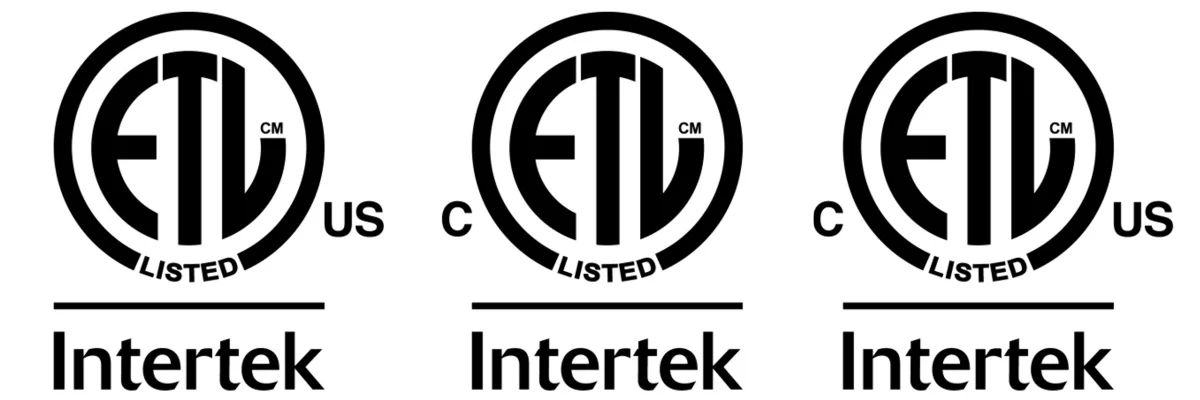
ETL Listed (US Only)
An ETL Listed mark with a “US” identifier indicates that the product is certified exclusively for the United States. In this case, the fixture is tested against relevant UL standards, such as UL 1598, to ensure compliance with the National Electrical Code (NEC). The evaluation focuses on U.S. electrical conditions, including voltage ratings, wiring practices, and safety labeling requirements written in English. For installations within the United States, this certification is generally sufficient for approval by local inspectors and AHJs.
cETL Listed (Canada Only)
When the ETL mark includes a “c” identifier, it signifies certification for use in Canada only. These products are tested to applicable CSA standards, including CSA C22.2 No. 250.0, in accordance with the Canadian Electrical Code (CEC). Canadian regulations introduce several distinct requirements. Safety markings must be bilingual in English and French, and there are additional rules related to grounding continuity and construction methods that differ from U.S. practices. A cETL mark confirms that these Canada-specific criteria have been met.
cETLus Listed (The Gold Standard)
A cETLus mark, displaying both the “c” and “US” identifiers, indicates that a fixture is certified for use throughout North America. Products with this designation are evaluated under harmonized standards, meaning they must comply with both UL and CSA requirements. Where differences exist between the two systems, the product is required to meet the more stringent rule for each individual component.
For projects that span the U.S. and Canada—or where future relocation is possible—cETLus certification provides maximum flexibility. Regardless of whether an inspection takes place under NEC or CEC rules, this mark ensures consistent acceptance by authorities having jurisdiction and reduces the risk of compliance-related delays.
Read more: Here is a full guide about lighting certification, like DLC, UL, ETL, CE, etc.
How to Verify an ETL Certificate?
For transparency and compliance verification, anyone can check the validity of an ETL mark on a lighting product.
- Locate the Control Number: Find the “ETL Listed” label on the lighting fixture. Look for a unique Control Number (typically 6 to 7 digits) printed near the logo.
- Access the Directory: Visit the official [Intertek Directory of Listed Products].
- Search the Database: Enter the Control Number into the search field.
- Confirm Details: The directory will output the manufacturer’s information and list the exact safety standards (e.g., UL 1598) the product was tested against.
Fazit
ETL certification is a critical indicator of electrical safety and regulatory compliance in the lighting industry. By relying on Intertek—a globally recognized NRTL—manufacturers can demonstrate that their fixtures meet the rigorous safety standards required by North American electrical codes.
Whether you are designing a new facility or upgrading an existing lighting system, ensuring your fixtures carry a valid NRTL mark (like ETL) guarantees that the equipment is safe for operation and ready to pass local inspection.
If you are evaluating ETL-certified lighting for your next project and have specific questions about compliance or technical specifications, our engineering team is available to assist you.
Frequently Asked Questions (FAQ)
Q: Is ETL as good as UL?
A: Yes. In terms of safety and legal compliance, they are identical. Both ETL (Intertek) and UL are Nationally Recognized Testing Laboratories (NRTLs) approved by OSHA. They test to the exact same safety standards (such as UL 1598). Having an ETL-listed fixture is legally equivalent to having a UL-listed one for inspection and insurance purposes.
Q: Is ETL equivalent to NSF certification?
A: No, they serve different purposes. This is critical for our food processing and agricultural clients.
- ETL certifies Electrical Safety (prevention of shock and fire).
- NSF (National Sanitation Foundation) certifies Sanitation & Hygiene (ensuring the fixture is easy to clean and won’t harbor bacteria).
For a food processing plant, you often need both.
Q: Does ETL certification guarantee high quality?
A: It guarantees Safety, but not necessarily performance. ETL proves the light won’t catch fire or shock you. However, it doesn’t measure energy efficiency or light quality. That is where DLC (DesignLights Consortium) comes in.
- ETL = Safety.
- DLC = Performance & Efficiency.
Q: Is ETL accepted by inspectors in the USA?
A: Yes. Since ETL is an OSHA-recognized NRTL, its certification is legally equivalent to UL. Electrical inspectors (AHJs) in all 50 states accept the ETL mark as proof of compliance with the National Electrical Code (NEC).

 English
 Français
 Deutsch
 日本語
日本語 Русский
 Español
 简体中文
简体中文